Why the distinction matters#
Continental drift and plate tectonics are not two names for the same theory. Continental drift proposed that continents had moved across Earth's surface and had once been joined. Plate tectonics explains motion through rigid pieces of lithosphere that include both continental and oceanic crust. Those plates form at spreading ridges, move relative to one another, descend at subduction zones, and slide past one another along transform boundaries.
Alfred Wegener's continental drift was an important precursor because it assembled evidence that continents had changed position. It did not provide the modern plate system or an adequate physical mechanism. Plate tectonics became persuasive only after researchers could explain the ocean floor, predict boundary behavior, and connect several independent kinds of evidence. The distinction is one of the major turning points in the broader history of geology.
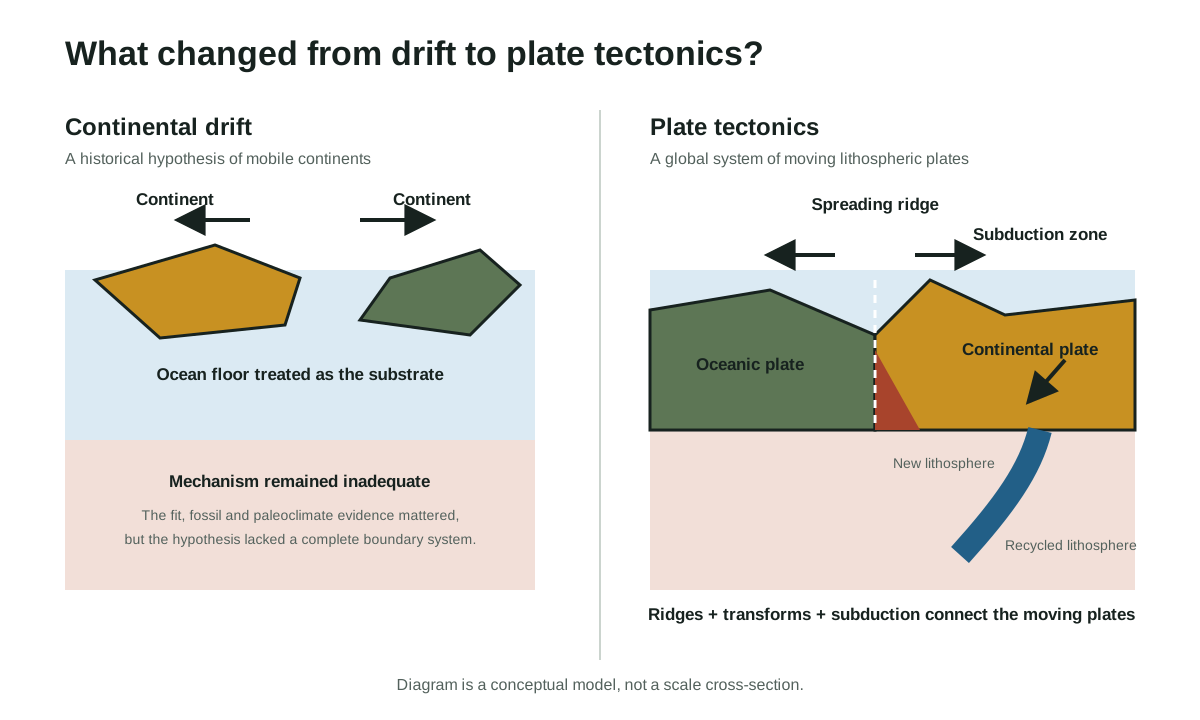
Continental drift and plate tectonics at a glance#
| Question | Continental drift | Plate tectonics |
|---|---|---|
| What moves? | Continents | Lithospheric plates containing continental crust, oceanic crust, or both |
| What happens to ocean floor? | It was not part of a complete creation and recycling system | It forms at ridges, moves with plates, and is recycled at subduction zones |
| What are the main boundaries? | No complete global boundary framework | Divergent, convergent, and transform boundaries |
| What supplied the mechanism? | Wegener's proposed forces were inadequate | Motion is part of a coupled mantle-lithosphere system; slab pull, ridge-related forces, and mantle flow all matter |
| How is motion described? | Mainly as changing continental positions | Quantitatively as relative plate motion on a sphere |
| Historical status | Crucial precursor | Current unifying framework for large-scale Earth tectonics |
What continental drift proposed#
Wegener argued in the 1910s that continents had once formed larger connected landmasses and later separated. He was not the first person to notice that opposite Atlantic margins appear to fit, but he turned scattered observations into a sustained research argument.
His case used more than coastline shape. It included matching fossil distributions across oceans, corresponding rock sequences and mountain belts, evidence of ancient glaciation across now-separated southern continents, and climate indicators found in places where they would be unexpected under modern geography. The USGS history of continental drift summarizes both this evidence and the objections that followed. Historical scholarship also shows that reception varied by country and discipline rather than following the popular story that everybody simply laughed at an obvious truth; Naomi Oreskes examines that history in The Rejection of Continental Drift.
Continental drift had a serious physical problem. Wegener proposed forces associated with Earth's rotation and tides, but they were far too weak to move continents as he imagined. Continents were also commonly pictured as pushing through stronger, fixed ocean crust. Geophysicists had good reason to reject that mechanism. This did not make the geological matches worthless. It meant that a compelling pattern lacked a workable global process.
That distinction matters in science. A proposal can identify a real phenomenon while explaining it incorrectly. Wegener deserves credit for making large continental motion a problem that could not be ignored, but he did not already possess the later theory of plate tectonics.
What plate tectonics changed#
Plate tectonics changed the mobile object. A continent is not an isolated raft crossing a stationary seafloor. Continental crust is carried within a larger plate of lithosphere, the strong outer shell made of crust and the uppermost mantle. A plate can contain a continent, ocean basin, or parts of both.
The theory also made ocean floor active and temporary. New oceanic lithosphere forms near mid-ocean ridges and moves away from them. Older oceanic lithosphere can bend and descend into the mantle at subduction zones. Transform faults accommodate sideways motion between other boundary segments. These processes create a connected global system rather than a theory only about continents.
Plate tectonics does not reduce plate motion to one simple conveyor belt in the mantle. Dense sinking slabs can exert a strong pull, elevated ridges contribute gravitational forces, and mantle circulation interacts with plates. Their relative importance varies with the plate and setting. The framework remains testable even though researchers continue to investigate how subduction begins, how diffuse continental deformation works, and how tectonics differed on the early Earth.
The evidence that completed the change#
No single observation established plate tectonics. The theory succeeded because evidence from different instruments and specialties converged.
- Ocean mapping revealed a structured seafloor. Echo sounding exposed continuous mid-ocean ridges, deep trenches, fracture zones, and abyssal plains. Marie Tharp turned sounding profiles into maps that made the Mid-Atlantic Ridge and its central rift visible. Her work and its initially contested reception are documented by the Lamont-Doherty Earth Observatory archive.
- Seafloor spreading supplied a process. Harry Hess proposed that new seafloor formed at ridges, moved outward, and was consumed near trenches. He presented it as a hypothesis to be tested, not as a completed theory. The USGS account of Hess and seafloor spreading explains why this removed the need for continents to force their way through fixed ocean crust.
- Magnetic stripes supplied a risky test. As magma cooled at a ridge, magnetic minerals recorded the direction of Earth's magnetic field. Because the field has reversed many times, spreading should produce matching bands of normal and reversed polarity on opposite sides of a ridge. Frederick Vine and Drummond Matthews set out this interpretation in their 1963 paper, Magnetic Anomalies Over Oceanic Ridges. The symmetry, order, and width of the bands connected magnetic reversals to seafloor creation and spreading rate.
- Transform faults predicted earthquake behavior. J. Tuzo Wilson recognized a boundary type that connects offset ridge segments and other plate boundaries. His model predicted which parts of an apparent offset should be seismically active and the direction of motion. That prediction could be checked against earthquakes. Wilson's original paper, A New Class of Faults and Their Bearing on Continental Drift, and the USGS explanation of transform faults show why this was more than a new label.
- Earthquakes revealed descending slabs and plate edges. Shallow earthquakes trace many ridges and transforms, while inclined zones of increasingly deep earthquakes descend beneath trenches and volcanic arcs. Those patterns helped identify subduction as the return path for oceanic lithosphere.
- Plate kinematics made the theory quantitative. Plates moving over a sphere can be described with rotations. Dan McKenzie and Robert Parker demonstrated this approach in The North Pacific: An Example of Tectonics on a Sphere. A global map of connected plates could now be tested against boundary directions and rates rather than remaining a loose story about wandering continents.
Later drilling found the predicted broad age pattern: young oceanic crust near ridges and progressively older crust away from them. Modern geodesy measures present plate motion directly. These later checks strengthened a framework already built from oceanography, magnetism, seismology, geology, and mathematics.
Why the mechanism objection changed#
Wegener's critics asked how buoyant continents could plow through ocean crust. Plate tectonics changed the question. Continental and oceanic crust are parts of moving lithospheric plates, and oceanic lithosphere can be created and destroyed. The old mechanical picture did not need to be rescued because it was replaced.
This is why it is misleading to say that Wegener's theory was finally accepted without qualification. Continental mobility was accepted, but within a different physical and geometrical framework. Plate tectonics incorporated some of drift's strongest evidence while discarding its inadequate mechanism and adding an ocean-centered evidence system.
Misconception checks#
- Continents do not move alone. They move as parts of lithospheric plates.
- Plate tectonics is not just seafloor spreading. It also requires subduction, transforms, and global plate geometry.
- Wegener was not rejected only because scientists resisted change. His proposed forces were physically inadequate, although some evidence and some supporters were also undervalued.
- Matching coastlines are not enough by themselves. Fossils, rocks, paleoclimate, marine magnetism, earthquakes, ocean-floor ages, and measured motion provide independent tests.
- Mantle convection is not a single motor dragging every plate at one speed. Plate and mantle dynamics are coupled, and several forces contribute.
- A successful theory can remain incomplete. Plate tectonics organizes large-scale observations while leaving active questions about driving forces, boundary zones, and early Earth behavior.
A useful way to remember the difference#
Continental drift identified a real historical result: continents have changed position. Plate tectonics supplied the larger system: whole lithospheric plates move, ocean floor is created and recycled, three boundary types connect globally, and the motion can be tested quantitatively.
The important change was therefore not merely better evidence that continents move. It was a new account of what moves, what happens to oceanic lithosphere, where motion is concentrated, and which observations the theory should predict.
Sources and further reading
Citations are placed beside the claims they support. This list gathers the external sources used on this page.
- Historical perspective: From continental drift to plate tectonicsU.S. Geological Survey | official educational source
- The Rejection of Continental Drift: Theory and Method in American Earth ScienceNaomi Oreskes | academic book
- About Marie TharpLamont-Doherty Earth Observatory, Columbia University | official institutional biography
- Harry Hammond Hess: Spreading the seafloorU.S. Geological Survey | official educational source
- Magnetic anomalies over oceanic ridgesFrederick J. Vine and Drummond H. Matthews | original scientific paper
- A new class of faults and their bearing on continental driftJ. Tuzo Wilson | original scientific paper
- J. Tuzo Wilson: Discovering transforms and hotspotsU.S. Geological Survey | official educational source
- The North Pacific: an example of tectonics on a sphereDan McKenzie and Robert L. Parker | original scientific paper
Continue learning
- Compare another model debateUniformitarianism, Catastrophism, and Actualism ExplainedSee why modern actualism allows gradual change and rare catastrophes.
- Trace the wider historyThe History of Geology: How Scientists Learned to Read Earth's Deep HistoryTrace how field evidence, instruments, institutions and theories changed.
Check a claim against the references above, then read our corrections and sourcing standards.