Why the old binary fails#
Uniformitarianism and catastrophism are not simply "slow change" and "fast change." Historical uniformitarianism combined several claims about natural laws, observable causes, rates, and the overall direction of Earth history. Historical catastrophism also covered several different programs, from evidence-based arguments about extinction and abrupt regional change to much broader speculative schemes.
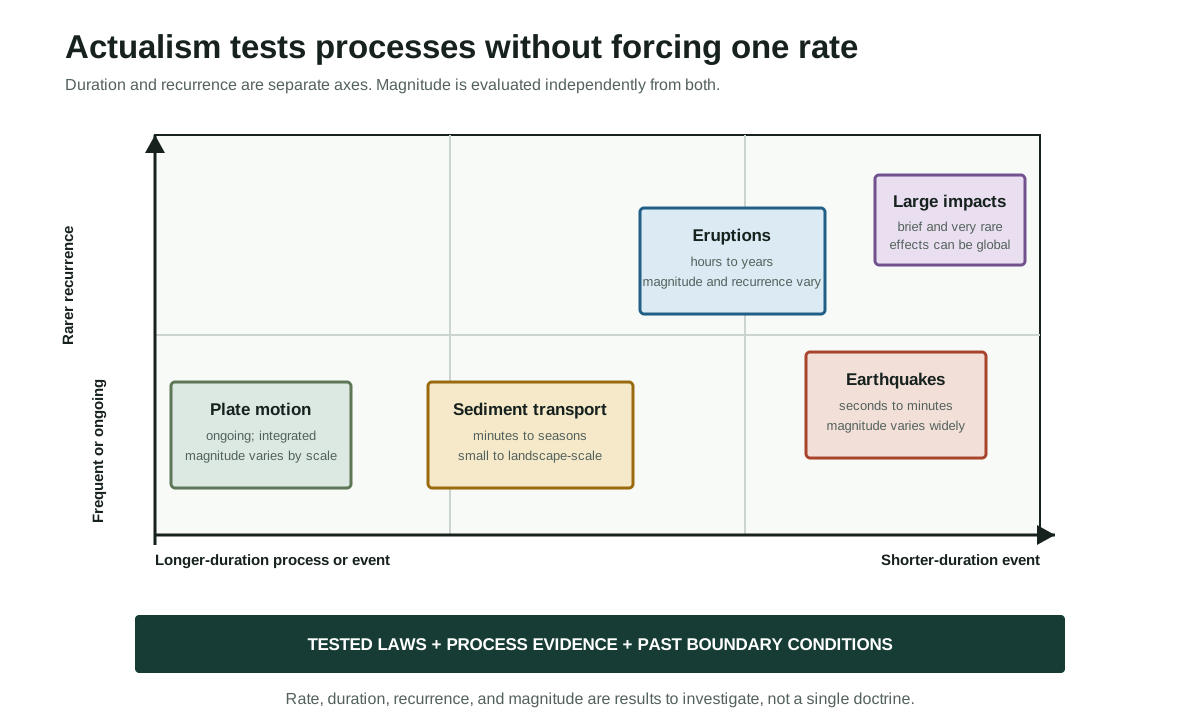
Modern geology is better described by actualism. Geologists use tested natural laws and processes to interpret past events, but they do not assume that every process had the same rate, magnitude, frequency, or combination seen today. An earthquake, impact, eruption, flood, or rapid extinction can be both catastrophic and entirely compatible with actualist reasoning.
This distinction matters because the old binary distorts the broader history of geology and the way geological evidence is evaluated today.
Three terms compared#
| Term | Central question or claim | What remains useful | What should not be assumed |
|---|---|---|---|
| Uniformitarianism | Can past change be explained through causes and laws known from nature? | Continuity of natural law and the use of observable processes | That every change is slow, steady, or identical in rate |
| Catastrophism | Did Earth history include abrupt events, discontinuities, and major biological or physical change? | Recognition that rare, high-magnitude events can leave diagnostic records | That all catastrophists held one doctrine or rejected natural explanation |
| Actualism | Which tested processes and laws can account for the evidence under past conditions? | Present evidence, experiments, physics, and modern analogs used critically | That the present is an exact copy of every past environment |
Why uniformitarianism has more than one meaning#
Charles Lyell's Principles of Geology argued that former changes to Earth's surface should be explained through causes now in operation. His books assembled observations of rivers, volcanoes, earthquakes, coasts, sedimentation, and organisms into a powerful historical method. The digitized first volume of Principles of Geology shows both the breadth of the evidence and the stronger historical program Lyell built around it.
The later word uniformitarianism compresses several propositions that need to be separated:
- Uniformity of law means that physical and chemical laws do not arbitrarily change from one geological period to another.
- Uniformity of process means that processes tested in nature, experiments, and models can help explain ancient evidence.
- Uniformity of rate means that change generally proceeds at similar or gradual rates.
- Uniformity of state means that Earth has no strong overall direction and remains broadly balanced through time.
A modern scholarly review traces these distinct meanings and explains why treating uniformitarianism and actualism as simple synonyms creates confusion. Romano, "Reviewing the Term Uniformitarianism in Modern Earth Sciences"
Modern geology depends heavily on the first proposition and uses the second with care. It does not require the third or fourth. Rates vary enormously, and Earth has undergone directional changes in atmosphere, oceans, continents, climate, and life.
James Hutton's earlier cyclic Earth also used observable processes such as erosion, deposition, consolidation, and uplift to infer immense duration. His Theory of the Earth and John Playfair's later Illustrations of the Huttonian Theory were important to this process-based view. Neither work should be reduced to the slogan that everything happens slowly.
Why catastrophism was not one doctrine#
Catastrophism is often presented as an unscientific belief defeated by patient field observation. That is poor history. Georges Cuvier used comparative anatomy and fossil mammals to demonstrate that organisms had become extinct. With stratigraphic work in the Paris Basin, extinction and faunal change made discontinuity part of empirical Earth history. A digitized edition of Cuvier's Essay on the Theory of the Earth provides the primary historical context.
Not every catastrophe-based reconstruction was equally well supported. Some writers proposed poorly constrained global events or forced varied deposits into a predetermined chronology. Cuvier's regional revolutions, scriptural flood interpretations, and modern impact science are not interchangeable. Treating them as one doctrine hides the questions that matter: What happened? Over what area? How quickly? By what mechanism? What evidence would distinguish that event from an alternative?
Historical analysis in Martin Rudwick's Earth's Deep History shows why a simple victory story fails. Researchers arguing about gradual and abrupt change were also debating fossil evidence, regional correlations, rates, causes, and the limits of the preserved record.
What actualism means in practice#
Actualism is a method for reasoning from evidence, not a claim that the past copied the present. A geologist starts with an observation, identifies processes capable of producing it, and tests those processes against physical constraints and independent evidence. Modern examples, experiments, and models are useful because they reveal mechanisms. They are not templates that must match every ancient event in size or setting.
| Evidence in a rock record | Actualist question | Important qualification |
|---|---|---|
| Tilted layers cut by erosion and covered by younger layers | Can deposition, deformation, erosion, and renewed deposition produce this geometry? | The sequence records several events and an unknown amount of missing time |
| A graded bed with sedimentary structures | Which flows sort grains this way? | An ancient flow may differ greatly in size from a monitored modern example |
| Shocked minerals, ejecta, and a crater structure | Can a high-energy impact produce the combined evidence? | A rare catastrophe can still be explained through tested physics |
| A sudden fossil turnover across a boundary | Does it reflect extinction, migration, environmental change, erosion, or missing record? | Fossil preservation and sampling must be tested before assigning a cause |
The same logic explains why actualism can include processes no person has watched from beginning to end. No observer has witnessed an ocean basin open and close over hundreds of millions of years. Researchers can still test the components through plate motion, rocks, structures, geophysics, experiments, and models. The process is constrained by present evidence without assuming an unchanging Earth.
Rates, events, and geological time#
Geological rates span many orders of magnitude. An earthquake rupture may last seconds. An eruption can transform a landscape in days. A flood can deposit a thick bed in hours, while soil formation or sediment accumulation may take far longer. Mountain belts and ocean basins develop through many events over millions of years.
Fast and slow processes also interact. Long-term plate motion loads faults that fail suddenly. Gradual burial prepares rocks for deformation or metamorphism. Slow environmental change can bring a system near a threshold, after which a rapid transition occurs. A thin event bed can be preserved inside a much longer sequence of ordinary sedimentation.
The correct question is therefore not whether a proposed change is gradual or catastrophic. It is whether the proposed rate, extent, process, and sequence explain the observations better than alternatives.
Fossils, strata, and independent clocks#
The uniformitarianism-catastrophism debate is often confused with dating. Relative geological order comes from field relationships, fossil succession, and correlation. Numerical ages come from suitable isotope systems and other calibrated methods. These evidence systems can check one another without being identical.
For example, a fossil assemblage may correlate layers in two basins, while a dated volcanic ash bed independently anchors part of the sequence. The worked evidence chain is explained in how fossils help geologists date rocks. The transition from relative sequences and physical clocks to isotope geochronology is covered in how scientists determined the age of Earth. Nature Education's overview of dating rocks and fossils using geologic methods provides a useful external summary of those cross-checks.
These methods do not assume that sedimentation was constant. Unconformities, erosion, variable accumulation, reworked fossils, and disturbed isotope systems are problems geologists actively diagnose. Evidence for changing rates is part of the interpretation rather than an exception that invalidates it.
Misconception checks#
- Uniformitarianism does not mean that every geological process is slow.
- Actualism does not mean that the present environment is identical to the past.
- A catastrophic event is not automatically supernatural or scientifically suspect.
- Historical catastrophists did not all hold the same theory.
- Lyell did not invent every use of present processes, and his complete historical program is not identical to modern geology.
- Rare events can be studied actualistically when they leave diagnostic evidence and obey testable natural laws.
- Gradual background change and sudden events can operate in the same geological history.
A better replacement for the old binary#
Modern geology asks whether tested natural processes, operating under stated past conditions and rates, can account for the preserved evidence. It allows both gradual change and well-supported catastrophes.
Uniformitarianism remains historically important, especially as a defense of natural law and observable causes. Catastrophism remains important as a reminder that Earth history contains discontinuities and high-magnitude events. Actualism keeps the useful methodological core while avoiding the claim that rates, environments, and outcomes must always remain uniform.
Sources and further reading
Citations are placed beside the claims they support. This list gathers the external sources used on this page.
- Principles of Geology, volume 1Charles Lyell | digitized primary book
- Reviewing the Term Uniformitarianism in Modern Earth SciencesMarco Romano | peer-reviewed review article
- Theory of the Earth; or an Investigation of the Laws Observable in the Composition, Dissolution, and Restoration of Land upon the GlobeJames Hutton | digitized primary paper
- Illustrations of the Huttonian Theory of the EarthJohn Playfair | digitized primary book
- Essay on the Theory of the EarthGeorges Cuvier; translated by Robert Kerr | digitized primary book
- Earth's Deep History: How It Was Discovered and Why It MattersMartin J. S. Rudwick | academic book
- Dating Rocks and Fossils Using Geologic MethodsNature Education contributors | scientific educational article
Continue learning
- Compare another theory changeContinental Drift vs Plate Tectonics: What Changed?Compare what moves, what happens to ocean floor and how the models are tested.
- Place the debate in contextThe History of Geology: How Scientists Learned to Read Earth's Deep HistoryTrace how field evidence, instruments, institutions and theories changed.
Check a claim against the references above, then read our corrections and sourcing standards.