What fossils can and cannot date#
Fossils help geologists determine the relative ages of sedimentary rocks because fossil species and fossil assemblages occur in a repeatable order through the rock record. If two separated rock layers contain the same short-ranging, well-understood assemblage, geologists can test whether the layers formed during the same interval. This is fossil succession and biostratigraphic correlation.
Fossils usually do not provide an age in years. They place a rock before, after, or within a known interval. A numerical date may instead come from suitable material above, below, or within the fossil-bearing sequence.
Fossils are most useful as ordered biological markers. They become stronger when several taxa agree and when field relationships, radiometric ages, or other independent evidence test the correlation.
Relative age is not the same as numerical age#
When geologists say that fossils "date" a rock, they may mean one of two different results.
| Result | Question answered | Typical evidence |
|---|---|---|
| Relative age | Is this layer older, younger, or equivalent in age to another layer? | Fossil succession, fossil assemblages, and the positions of fossil occurrences in measured sections |
| Numerical age | About how many years ago did the material form? | A suitable isotope system in a mineral or other material that can be measured and interpreted as a clock |
A correlation can be precise without carrying a number of years. It might place a bed between the first appearance of one taxon and the last appearance of another. Numerical geochronology can later calibrate that interval. The evidence used to determine Earth's age is a separate task.
Why fossil succession works#
Species originate, spread, change their geographic ranges, and disappear. Rocks from different intervals therefore contain different fossils. The U.S. Geological Survey calls this fossil succession and notes an important complication: organisms living in different environments at the same time do not leave identical assemblages. USGS, Fossil Succession
William Smith recognized that sedimentary units could be traced using their characteristic fossil assemblages. This did not mean that one shell assigned an automatic number to a bed. It meant that a recurring combination of fossils could identify a position in an observed sequence. The National Park Service summarizes the principle as a definite, recognizable order of fossil organisms through geologic time. National Park Service, Faunal Succession
This tool let geologists compare rocks across gaps and regions. In the broader history of geology, fossils became evidence for sequence, extinction, environments, and deep time.
What makes a fossil useful for correlation#
An index fossil is a fossil used to recognize a limited interval of rock. An especially useful index taxon has several practical qualities:
- a relatively short known range in geologic time;
- a wide geographic distribution;
- enough abundance to be found repeatedly;
- features that allow reliable identification;
- occurrence across the environments that need to be compared, rather than in only one narrow habitat.
No fossil is perfect. A widespread marine microfossil may correlate ocean sediments well but be absent from rocks deposited on land. A long-lived species may be easy to recognize yet constrain age only broadly. A rare species may have a short true range but appear shorter still because collectors miss it. Geologists therefore prefer assemblages and overlapping ranges rather than asking one specimen to carry the entire conclusion.
How a fossil correlation is built#
Step 1: Record fossils in their rock context#
A fossil without a reliable bed position has lost much of its dating value. Geologists record its layer, height, rock type, preservation, and nearby contacts. A loose specimen that weathered downhill cannot be assigned automatically to the bed where it was found.
Step 2: Identify taxa and plot observed ranges#
Geologists plot the lowest and highest observed occurrence of each taxon. Overlapping ranges create an assemblage or biozone. The first collected fossil need not be the first individual that lived, and the highest specimen need not mark the instant of global extinction.
Step 3: Compare more than one marker#
Suppose Taxon A has a long range, Taxon B occurs only in its middle, and Taxon C appears near the top. A bed containing A and B but not C is better constrained than one containing A alone. The same order in another basin supplies a testable correlation.
Step 4: Check the environmental setting#
Different rocks can form at the same time. Simultaneous shoreline sand and deeper-water mud may contain different organisms. Geologists compare environments and several fossil groups before treating absence as an age difference.
Step 5: Test and calibrate the sequence#
An independent marker can test the order. Suitable minerals in an ash bed may provide a numerical anchor. The American Museum of Natural History explains the common practice of dating volcanic layers above and below fossil-bearing rock rather than treating the fossil as the isotope clock. American Museum of Natural History, Dating Fossils and Rocks
A two-basin example#
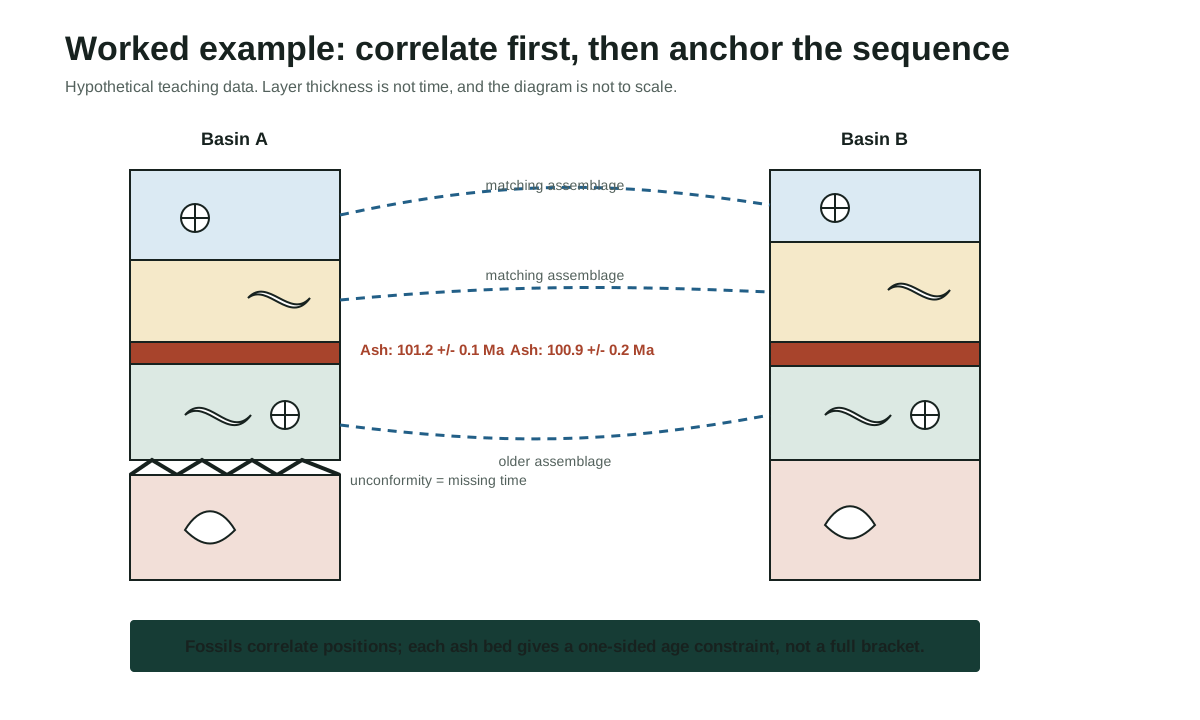
Consider two basins. These taxon labels form a teaching model, not real species.
| Position | West Basin | East Basin | Evidence-based interpretation |
|---|---|---|---|
| Upper beds | Taxon C appears; Taxon B disappears | Taxon C appears above the last Taxon B | Both sections pass through the same ordered turnover |
| Middle beds | Taxa A and B overlap | Taxa A and B overlap in a different rock type | The overlap supports correlation despite the change in sediment |
| Lower beds | Taxon A present; Taxon B absent | Taxon A present below the first Taxon B | The lower interval is older than the A-B overlap |
Now add an ash bed just above the A-B overlap in the West Basin. If suitable minerals in that ash yield a well-supported radiometric age, the age provides a one-sided numerical constraint: an intact fossil interval below it is older than the ash. The fossil sequence can transfer that constraint to the correlated East Basin interval, with uncertainty stated. A true numerical bracket would require an independently dated horizon on the other side as well. The example does not prove that every centimeter in both basins formed at exactly the same moment.
Limits and failure modes#
Biostratigraphy is powerful because its limitations can be investigated rather than ignored.
| Limitation | What can go wrong | How geologists respond |
|---|---|---|
| Reworking | Erosion removes an older fossil and redeposits it in younger sediment, making the fossil older than its enclosing bed | Inspect abrasion, breakage, mineral staining, mixed preservation, erosional surfaces, and the full assemblage |
| Facies control | A taxon appears absent because the environment was unsuitable, not because the time interval is missing | Compare environmentally similar settings, use multiple fossil groups, and interpret the rock environment |
| Range uncertainty | A local first or last occurrence reflects migration, local disappearance, or incomplete collecting rather than global origin or extinction | Replicate sections, increase sampling, and distinguish local observed ranges from wider calibrated ranges |
| Preservation | Soft-bodied organisms and delicate structures are less likely to fossilize, while some settings destroy remains | Treat absence cautiously and compare preservation conditions |
| Sampling | Rare fossils may be missed, especially in short field visits, small cores, or poorly exposed beds | Record sampling effort and seek repeated occurrences rather than relying on a single negative result |
| Identification | Similar species may be confused, or a classification may change with new study | Document diagnostic features, preserve specimens, and use specialist taxonomic review where needed |
Fossils are physical particles whose distribution can be shaped by erosion, transport, habitat, and deposition. A Geological Society of America study describes how discontinuous facies, incomplete sections, and reworking can distort the observed record. Fastovsky, Rocks, resolution, and the record
First and last appearances also depend on sampling. Facies, sampling intensity, and sedimentary architecture can make local occurrences differ from true origination and extinction. The Kansas Geological Survey chapter "Dependent and Independent Data in Paleontology" explains why fossil occurrence data must be interpreted independently from the sedimentary model they are used to test.
These controls explain why a responsible conclusion gives a range and confidence, not false precision.
Is fossil dating circular?#
The claim that "fossils date rocks, and rocks date fossils" leaves out how the evidence chain is built.
- Fossil order is first observed in physical sequences where bed relationships establish a local before-and-after order.
- The order is tested in additional sections. A useful succession predicts which assemblages should occur above or below others.
- Correlations use overlapping ranges and assemblages, not an unsupported age label attached to one fossil.
- Independent markers, including radiometrically dated volcanic layers, can calibrate and test the fossil sequence.
- New observations can revise a taxon's known range or reveal reworking, a gap, or an environmental restriction.
The method would be circular if geologists assigned an age to a fossil only because of a rock's assumed age and then used that same unsupported fossil age as the sole proof of the rock's age. That is not the actual workflow. Nature Education's overview treats relative ordering and radiometric dating as related but distinct methods that can cross-check a geological history. Nature Education, Dating Rocks and Fossils Using Geologic Methods
Does carbon dating date every fossil?#
No. Radiocarbon dating measures carbon-14 in suitable once-living material from the geologically recent past. It can be used on material much younger than 3,000 years; its practical upper reach is commonly around 50,000 years and depends on sample type, preparation, measurement, calibration and contamination. USGS, Radiometric Time Scale
Most familiar fossils and fossil-bearing rocks are far older than that range. Many fossils have also lost or exchanged their original carbon during fossilization. Older fossil-bearing sequences are commonly constrained by fossil succession and by other isotope systems measured in suitable minerals or associated volcanic material. "Radiometric dating" is a family of methods, not another name for carbon dating.
What a sound fossil-age claim should tell you#
Before accepting a correlation, ask:
- Was the fossil found in place, with a recorded bed and section?
- Is the identification secure enough for the proposed resolution?
- Is the conclusion based on one specimen or an assemblage?
- Could environment, preservation, sampling, or reworking explain the pattern?
- Is the stated age relative, numerical, or a calibrated range?
- What independent evidence tests the interpretation?
- Does the claimed precision match the fossil's actual known range?
A careful answer may be broader than a textbook label, but it is more useful. Fossils do not function as magic date stamps. They provide repeatable biological evidence that can connect separated records, reveal sequence, and be tested against other clocks and markers.
Check your understanding#
Self-check
Can you separate relative and numerical age?
Sources and further reading#
- U.S. Geological Survey: Fossils, Rocks, and Time - Fossil Succession
- National Park Service: Geologic Principles - Faunal Succession
- Nature Education: Dating Rocks and Fossils Using Geologic Methods
- American Museum of Natural History: Dating Fossils and Rocks
- Fastovsky: Rocks, Resolution, and the Record
- Kansas Geological Survey: Dependent and Independent Data in Paleontology
Sources and further reading
Citations are placed beside the claims they support. This list gathers the external sources used on this page.
- Fossil SuccessionU.S. Geological Survey | official educational publication
- Geologic Principles: Faunal SuccessionU.S. National Park Service | official educational source
- Dating Fossils and RocksAmerican Museum of Natural History | museum educational source
- Rocks, Resolution, and the Record: A Review of Depositional Constraints on Fossil Vertebrate Assemblages at the Terrestrial Cretaceous/Paleogene Boundary, Eastern Montana and Western North DakotaDavid E. Fastovsky | peer-reviewed scholarly chapter
- Dependent and Independent Data in Paleontology: Tools for the Sedimentary ModelerChristopher G. Maples and Ronald R. West | official survey scholarly publication
- Dating Rocks and Fossils Using Geologic MethodsNature Education contributors | scientific educational article
- Geologic Time: Radiometric Time ScaleU.S. Geological Survey | official educational publication
Continue learning
Check a claim against the references above, then read our corrections and sourcing standards.