What the 4.54-billion-year estimate means#
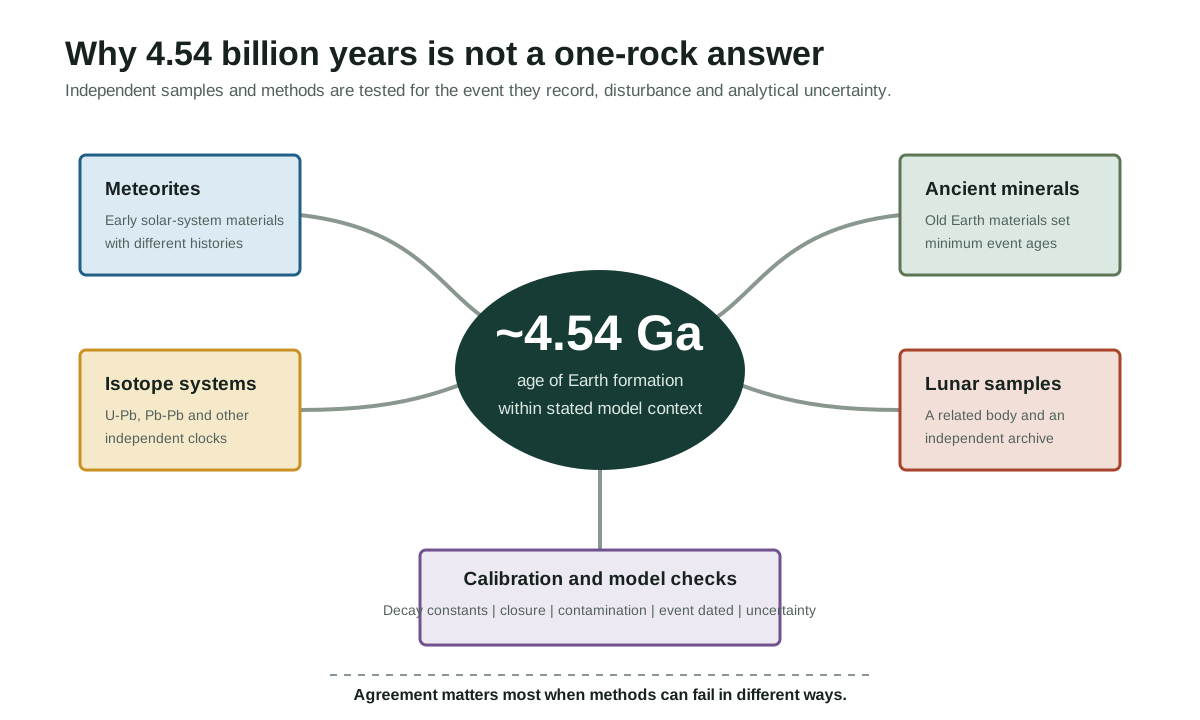
Earth is about 4.54 billion years old. That number is not the date of one unusually old Earth rock, and it did not come from a single meteorite or one untested assumption. It is an inference from many measurements that agree: lead-isotope relationships in several meteorites, other radiometric systems, ancient minerals and rocks on Earth, lunar samples, and the relative order recorded by geology.
Meteorites are central because Earth has repeatedly melted, differentiated, weathered, and recycled its crust. Few terrestrial materials preserve the planet's beginning. Primitive meteorites preserve material formed during the birth of the Solar System, when Earth was also assembling. The accepted age therefore describes an interval of planetary formation, not a birthday that occurred in one instant.
What does "the age of Earth" mean?#
A planet forms through a sequence of events. Dust and small bodies accrete; a growing world heats and separates into core, mantle, and crust; impacts add and remove material; minerals crystallize at different times. A numerical age always dates a particular event recorded by a particular material.
This distinction prevents three common errors:
- The oldest known mineral from Earth gives a minimum age for part of the crust, not necessarily the time accretion began.
- The oldest surviving rock dates that rock's formation or later alteration, not the creation of all Earth material.
- A meteorite age dates an early Solar System event. It can constrain Earth's formation because meteorites and the planets formed from the same young Solar System, but that relationship must be argued and tested.
The U.S. Geological Survey explanation of Earth's age makes this logic explicit: old terrestrial rocks show that Earth is at least very old, while meteorites provide access to material whose history reaches closer to Solar System formation. The result is approximately 4.54 billion years, commonly written with an uncertainty of roughly 0.05 billion years when describing Earth's formation at this level.
Relative time came before a reliable numerical clock#
Long before geologists could assign years, they could reconstruct order. A sedimentary bed lies above an older undisturbed bed. An intrusion is younger than the rock it cuts. Fossil assemblages appear in a repeatable succession. These relationships established a long, eventful history without saying exactly how many years it occupied. The same logic still cross-checks numerical dates; our lesson on how fossils help date rocks explains one part of that system.
Natural philosophers and scientists tried several clocks. They estimated time from sediment thickness, erosion, ocean chemistry, and the cooling of a hot Earth. Each attempt was useful because it turned a broad historical question into a model with quantities and assumptions. Each also encountered processes that its simple version could not adequately represent, such as missing sediment, changing rates, or material entering and leaving an ocean.
Evidence tool
How Earth-age estimates changed
Filter by the kind of clock. A newer estimate was not automatically better; the assumptions and sample history mattered.
| Period | Person or program | Method | Result | Later assessment |
|---|---|---|---|---|
| Antiquity–early modern period | Religious, dynastic, philosophical, and calendrical chronologies | Textual genealogies, cycles, cosmologies, historical reckoning | Many different values and frameworks | Not geological measurements; historically diverse. |
| Late 17th century | Edmond Halley and related proposals | Ocean salinity accumulation and other natural clocks | Programmatic rather than a reliable modern value | Open-system behavior and unknown initial conditions made the clock inadequate. |
| 1770s | Buffon | Cooling experiments on heated spheres extrapolated to Earth | Tens of thousands of years in published work; longer privately considered | Model and scale limitations; still historically important. |
| Late 18th century | James Hutton | Cyclic geological reasoning from erosion, deposition, consolidation, uplift | No finite numerical estimate; duration beyond recoverable observation | Deep time without a numerical clock. |
| 19th century | Sedimentation and denudation estimates | Thickness divided by assumed rates; erosion budgets | Usually millions to hundreds of millions of years, highly variable | Rates vary and records contain hiatuses, recycling, and incompleteness. |
| 1860s–1890s | William Thomson (Lord Kelvin) and thermal physicists | Conductive cooling of an initially hot Earth | Estimates changed; commonly tens of millions of years in later discussions | Mantle convection and radioactive heat invalidate the simple conductive model; Perry's critique matters. |
| 1899 | John Joly | Ocean sodium accumulation | Roughly on the order of 100 million years in historical estimates | Ocean chemistry is an open, cycling system. |
| 1904–1907 | Rutherford and Boltwood | Radioactive decay and uranium-lead relations | Some rocks assigned ages of hundreds of millions to billions of years | Method became robust through isotope geochemistry, calibration, and concordance tests. |
| 1913 | Arthur Holmes | Compilation and interpretation of radiometric ages | Earth at least around 1.6 billion years in his early synthesis, with later revisions | Early values were limited by constants and analytical precision, but the framework endured. |
| 1920s–1940s | Holmes and isotope geochronologists | Improved uranium-lead and lead-isotope methods | Multi-billion-year Earth increasingly accepted | Precision and inter-method checks continued to improve. |
| 1956 | Clair C. Patterson | Lead-isotope systematics of meteorites and terrestrial lead reservoirs | About 4.55 billion years | Close to current accepted value; strengthened by many independent data sets. |
| Late 20th century–present | Modern geochronology | Multiple isotope systems, meteorites, lunar samples, oldest terrestrial minerals, high-precision mass spectrometry | Approximately 4.54 billion years for Earth; uncertainty depends on what event is being dated | Not one rock, one isotope system, or one untested assumption. |
Source: curated research records based on S005 and S018-S022. Values are historical summaries, not a replacement for the cited analyses.
Kelvin was not simply foolish, and Perry matters#
William Thomson, later Lord Kelvin, treated Earth as a once-hot body losing heat mainly by conduction. In the nineteenth century he published estimates that changed as his inputs and reasoning changed, but the later values commonly discussed were in the tens of millions of years. That conflicted with the much longer duration many geologists and biologists thought their evidence required.
Kelvin's calculation was serious physics applied to an incomplete thermal model. The problem was not merely that radioactivity had yet to be discovered. In 1895, Kelvin's former assistant John Perry argued that a mobile or effectively convecting interior beneath a relatively thin conductive outer layer could maintain the observed temperature gradient for far longer. Perry's primary paper in Nature and a later historical analysis of his neglected critique show why the familiar story - Kelvin forgot radioactivity and was therefore wrong - is incomplete.
Radioactive decay did add an internal heat source that Kelvin's original model lacked. Mantle convection also changed how surface heat flow relates to the planet's total cooling history. The larger lesson is methodological: a precise calculation is only as reliable as its model, boundary conditions, and measured inputs.
How a radiometric clock works#
Some atomic nuclei are unstable. A parent isotope transforms into a daughter isotope at a statistically predictable rate. A half-life is the time in which half of a large population of parent atoms is expected to decay. A mass spectrometer can measure isotope ratios in a mineral with high precision.
A radiometric date is not simply "amount of daughter divided by decay rate." A geochronologist asks what event started or reset the clock and whether the mineral subsequently remained sufficiently closed to the relevant parent and daughter isotopes. Crystallization, cooling, metamorphism, weathering, or later heating can have different meanings for different minerals and isotope systems. The USGS beginner's guide to dating rocks emphasizes that methods are selected for the material and event being studied.
Several features make radiometric dating testable rather than circular:
- Decay constants and isotope ratios can be measured independently of the age sought.
- Different parent-daughter systems have different half-lives and chemical behavior.
- Multiple minerals from one rock can be compared, and multiple samples can define an isochron rather than requiring an assumed initial daughter amount.
- In uranium-lead work, two uranium decay chains provide an internal comparison. Disturbance can produce discordance rather than a convenient valid age.
- A date can be checked against superposition, cross-cutting relationships, fossils, magnetic reversals, and dates from nearby units.
- Replicate measurements, reference materials, blanks, and interlaboratory comparisons can expose contamination or analytical bias.
Real samples do fail tests. Lead may be lost, inherited crystals may predate the rock containing them, or an isotope system may record metamorphism instead of original crystallization. Those are geological signals to investigate, not permission to accept whichever number is preferred. A defensible published age identifies the material, method, measured ratios, uncertainty, and interpreted event.
Why meteorites answer an Earth question#
Earth's active rock cycle has erased or altered most direct records of its assembly. Meteorites offer a different archive. Many are fragments of bodies that formed early and did not undergo all the recycling experienced by a large, active planet. If meteorites from distinct parent bodies record closely related early ages, and terrestrial lead evolved consistently with the same starting system, a common Solar System chronology can be tested.
Clair Patterson's 1956 paper, "Age of Meteorites and the Earth", reported that meteorites agreed within experimental error under three radiometric approaches. Its lead-lead result was 4.55 +/- 0.07 billion years. Patterson compared lead isotope compositions from multiple meteorites and terrestrial lead reservoirs. Canyon Diablo material was important because its iron sulfide supplied lead with very little uranium, helping constrain the initial lead composition; it was not a magical rock whose age was simply assigned to Earth.
The paper's inference included model assumptions: meteorites and Earth shared an early Solar System history, and the lead isotope reservoirs evolved in describable ways. Later measurements did not freeze the 1956 analysis in place. They improved decay constants, mass spectrometry, contamination control, sample selection, and models of early Solar System events. A USGS technical review of radiometric dating and Earth age explains how iron- and stone-meteorite lead compositions form the relevant isotope relationship.
Convergence is stronger than one famous measurement#
The case for an ancient Earth is powerful because evidence with different vulnerabilities converges.
| Evidence | What it dates or constrains | Why it is not sufficient alone |
|---|---|---|
| Primitive meteorites and their components | Early Solar System formation events | Earth assembled over an interval and is not identical to every meteorite parent body |
| Lead-isotope systematics | Time since reservoirs began evolving from early lead | Requires measurements from multiple reservoirs and an explicit evolution model |
| Ancient terrestrial minerals and rocks | Formation or later resetting of surviving Earth material | Recycling means the oldest survivor need not be the first material |
| Lunar samples | Early events in the Earth-Moon system | The Moon has its own impact and thermal history |
| Relative geology and fossils | Order and correlation of events | Usually do not provide the planet's numerical formation age by themselves |
| Other isotope systems | Independent ages for suitable materials and events | Every system has material-specific closure and interpretation requirements |
Agreement does not mean every dated object returns 4.54 billion years. It should not. A younger volcanic rock ought to record its eruption or cooling, while an ancient zircon may preserve a much earlier crustal event. The pattern that matters is coherent ordering and agreement where different clocks date the same event.
What the uncertainty means#
"About 4.54 billion years" is more honest than a long string of digits. Uncertainty comes in layers:
- Analytical uncertainty describes how precisely isotope ratios were measured.
- Calibration uncertainty includes decay constants and standards shared by many analyses.
- Geological uncertainty asks whether a sample remained closed or was disturbed.
- Model uncertainty concerns the relationship between the dated reservoir and planetary formation.
- Event-definition uncertainty reflects that accretion, core formation, and later giant impacts did not occur simultaneously.
These uncertainties are not evidence that any age is equally plausible. They define the range and meaning of a result. Tens of millions of years are a small percentage of 4.54 billion years but still a substantial interval in early planetary history.
What could challenge the conclusion?#
A scientific age must be open to revision. Confidence would fall if well-characterized early Solar System samples repeatedly produced incompatible ages across independent isotope systems, if measured decay behavior failed under relevant conditions, or if terrestrial, lunar, and meteoritic isotope evolution could not be reconciled. Instead, better instruments and additional samples have refined the chronology while preserving the broad result.
That is why the strongest statement is not "Patterson proved Earth's exact birthday." It is this:
Multiple testable clocks and geological records converge on an Earth that formed about 4.54 billion years ago. Patterson's work was pivotal, but the accepted age belongs to a continuing body of evidence.
This evidentiary shift is one chapter in the wider history of geology: relative sequences established deep time, physical models made assumptions visible, isotope geochemistry supplied numerical clocks, and later work kept testing what those clocks record.
Sources and further reading
Citations are placed beside the claims they support. This list gathers the external sources used on this page.
- Geologic Time: Age of the EarthU.S. Geological Survey | official educational source
- The Age of the EarthJohn Perry | primary scientific paper
- John Perry's neglected critique of Kelvin's age for the Earth: A missed opportunity in geodynamicsPhilip C. England, Peter Molnar, and Frank M. Richter | peer-reviewed historical analysis
- A beginner's guide to dating rocksU.S. Geological Survey, Yellowstone Volcano Observatory | official educational article
- Age of meteorites and the EarthClair C. Patterson | original scientific paper
- Radiometric Dating, Geologic Time, and the Age of the Earth: A Reply to Scientific CreationismG. B. Dalrymple, U.S. Geological Survey | official technical report
Continue learning
- Stay with dating evidenceHow Fossils Help Geologists Date RocksWork through fossil correlation, numerical anchors and common failure modes.
- See how a theory gained a mechanismContinental Drift vs Plate Tectonics: What Changed?Compare what moves, what happens to ocean floor and how the models are tested.
Check a claim against the references above, then read our corrections and sourcing standards.